


Q&A with Dr. Steve Boyes
There are few voices capable of holding up a mirror to the travel industry and asking not just where we go, but why. Fewer still can do so with lived authority, scientific rigour, and an unflinching devotion to Africa’s wild places. Steve Boyes is one of them.
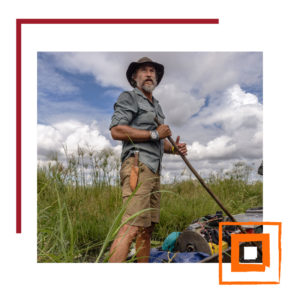
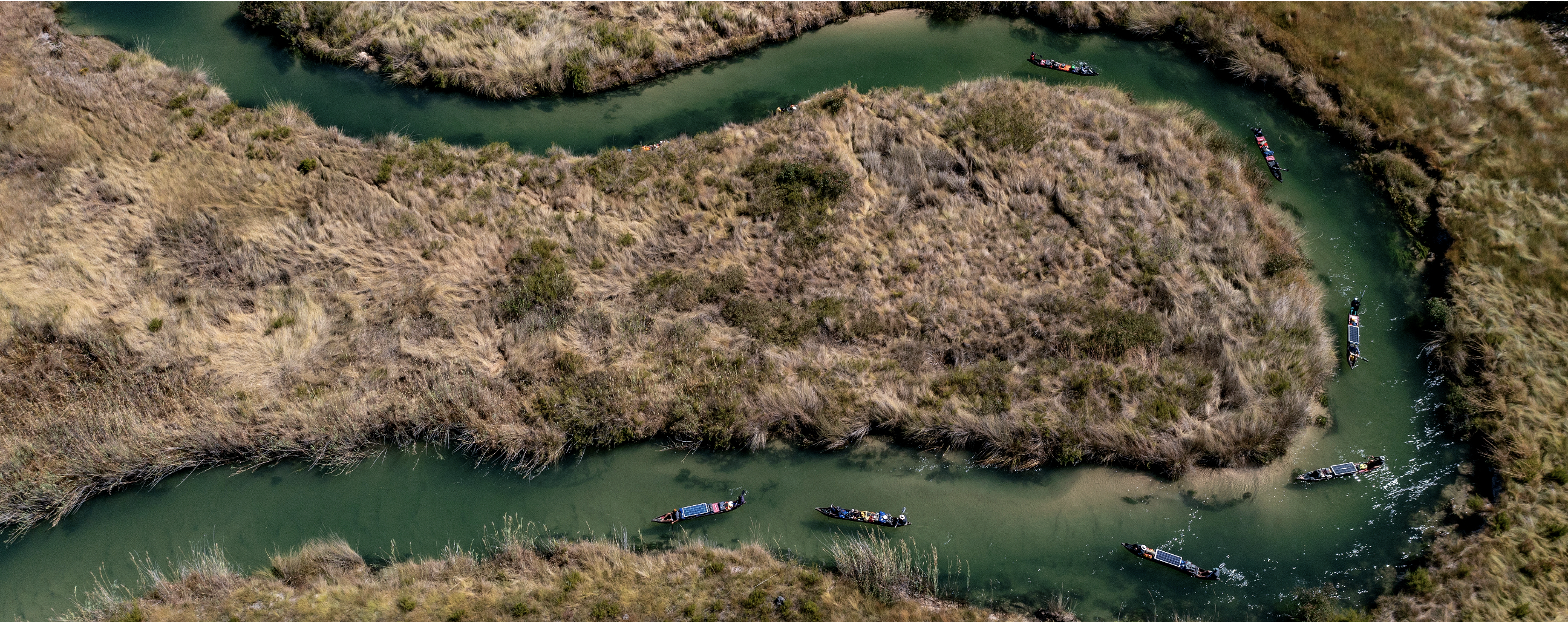
A National Geographic Explorer and Explorer of the Year, Boyes has spent his life moving through Africa’s last intact wildernesses by dug-out canoe, on foot, and by bicycle – tracing the unseen systems that sustain them. His work takes him into the depths of the Angolan highlands and across the waterways of the Okavango Delta, mapping the fragile water towers that feed two-thirds of Africa’s economy and hold the future of its biodiversity in balance. This is exploration not for spectacle, but for protection.
Through landmark partnerships with National Geographic, Rolex’s Perpetual Planet Initiative, Disney, and a global community of scientists and storytellers, Boyes has helped redefine what modern exploration looks like, and what it demands of those who benefit from wild places. Building on the success of the National Geographic Okavango Wilderness Project, in 2018 Boyes formed The Wilderness Project to study and safeguard Africa’s major river basins. Four years later, with the support of the Rolex Perpetual Planet Initiative, he launched his young organization’s most ambitious venture yet, the Great Spine of Africa series of expeditions. These undertakings are providing the first scientific baselines of Africa’s major water towers, (areas that act as natural water stores) and investigating their role as the sources of the Zambezi, Congo, Niger and Nile rivers, on which two-thirds of Africa’s economy depend.
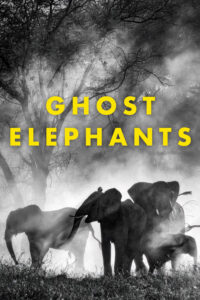
His recent film release “Ghost Elephants” and his forthcoming book, Okavango: The Source of Life – Exploring Africa’s Lost Headwaters, bring these invisible lifelines into sharp focus, offering a rare view of wilderness as a living system rather than just a destination.
At We Are Africa 2026, Boyes stands firmly within our Wild With Purpose campaign – his work challenges the notion of wilderness as a backdrop for experience, instead positioning it as a responsibility shared by explorers, conservationists, and the travel community alike.
In this conversation, Steve Boyes speaks not only as a guardian of the wild, but as a thinker shaping how Africa’s future is explored, protected, and valued.
His perspective reminds us that purpose is not something layered onto travel rather it is something earned, step by step, mile by mile, in service of the places that give so much back to us all in return.
- Wild With Purpose is about championing Africa, rather than trying to tame it. From your years exploring Africa’s great river systems, what does it truly mean to champion the wild, rather than manage or control it?
Championing is an act of allegiance. Ultimately, it’s about relationships, about aligning ourselves with forces far older and wiser than we are. Indigenous knowledge systems are “wild with purpose”. To champion Africa is to protect the conditions that allow complexity to persist: seasonal flooding, migration, fire, silence, uncertainty. Africa’s last wild places are unpredictable. They flood, burn, disappear, return. They refuse permanence. Management promises control and security, wilderness offers truth and resilience. Wild abundance doesn’t emerge from stability, it arises from constant movement. We need to champion language, culture, and tradition. We need to foster a sense of pride, ownership, community, and purpose. Rivers don’t need us to decide where they should go. The future of wildlife tourism and conservation is local. What is your localization plan?
- Your work focuses on the fundamental sources of life – headwaters, peatlands, and water towers that most people will never see. Why do you believe protecting what’s invisible is one of the most urgent challenges facing Africa today?
Africa’s great river basins are a patchwork mosaic of interconnected watersheds, binding plants, wildlife, and people to ancient landscapes set between rivers, rift valleys, mountains, deserts, and coastal plains. We call this the “Great Spine of Africa”. Rivers unite and divide, connect and isolate. They bring new life and can wash it away.
Africa has the most free-flowing, unstudied rivers of any continent. The major river basins cover over 15 million square kilometres, more than half of the continent. Over 500 million people live in these basins, and more than two-thirds of all Africans depend on them. Rivers, from their sources to their ends, are the lifeline of any continent. They are the water and nutrient pumps that sustain biodiversity, wildlife, people and ecosystems..
Africa’s watersheds, water towers, and wetlands aren’t dramatic in the way rainforests, deltas, or savannas are, yet they determine whether life downstream thrives or dies. In our detailed studies of Africa’s major rivers from their little-known sources, we’re finding that Africa is far more resilient to the long-term impacts of climate change than previously assumed.
You’re correct. The sources are seldom seen by people from the outside world. I’ve learnt that invisibility isn’t insignificance, it’s vulnerability. These forested watersheds exist beyond the horizon of most decision-making, which means they’re often allowed to be drained, logged, mined, and fragmented without adequate consideration of the downstream consequences. Years later, drought, flood, hunger, or conflict arise.
- You’ll be joining the We Are Africa tribe in Cape Town in 2026. What role do you believe the luxury travel industry can and must play in safeguarding Africa’s ecosystems beyond storytelling and inspiration?
Luxury has always been defined by rarity, care, and longevity. Africa’s wildlife tourism industry has the ability to reward restraint: low-density models, patience, seasonal sensitivity, and decisions that prioritise ecological function over short-term yield. When done properly, it can make intact ecosystems more valuable standing than converted, more profitable protected than exploited. If Africa is to remain wild with purpose, the luxury travel industry must move from being a narrator to being a participant. From celebrating beauty to underwriting its persistence. From selling experience to safeguarding the conditions that allow experience to exist at all.
In what I do, luxury tourism isn’t a high-value downstream water user capable of paying for ecosystems services like a clean, sustainable sources of freshwater upstream, but it does sit at the crossroads of influence, capital, and imagination where large-scale conservation programs can be funded, new government policies developed, and impactful stories about these wild places told to a global audience.
The future of Africa’s ecosystems is inseparable from the dignity, agency, and leadership of the communities who live within them. Luxury travel can help anchor long-term employment, local ownership, and cultural continuity, supporting not just conservation outcomes, but, most importantly, fostering a sense of pride, ownership, community, and purpose.
- Through projects like the Okavango Wilderness Project and the Great Spine of Africa expeditions, you’ve worked closely with local communities over many years. What does true guardianship look like when conservation, culture, and livelihoods are deeply intertwined?
You must all listen to our podcast series, “Guardians of the River”, which won at the Tribeca Film Festival and became the 2nd most listened to podcast on iTunes. In the Angolan Highlands, around the source of the Okavango, Kwando, and Zambezi, we listened for seven years, studying and reflecting, before establishing a “Conservation Development Node” that supports traditional leaders and indigenous knowledge as the primary mechanism for long-term, sustainable protection.
Landscapes, especially rivers, endure not because they’re managed from afar, but because people belong to them. River guardians are farmers, fishermen, and traditional leaders – mothers, fathers, and children – attuned to seasonal change, scarcity, abundance, and uncertainty. They act through shared time, shared risk, and shared decision-making systems. This is Africa. Protecting a wetland, a forest, or a migration route can’t come at the expense of dignity or opportunity, meaning this action must align ecological function with human well-being, supporting traditional livelihoods that depend on intact ecosystems. The luxury tourism industry can support and celebrate these local river guardians and ecosystem champions as part of the guest experience.
- Climate change is often spoken about in abstract terms. From what you’ve witnessed on the ground, how close are we to irreversible tipping points, and where does purposeful tourism still have the power to make a meaningful difference that inspires action and importantly, hope?
The El Niño Southern Oscillation is arguably the world’s most significant climatic phenomenon and is experienced across Sub-Saharan Africa, causing seasons to loosen from their old rhythms. Rains arrive late or all at once. Floods fail to spread, or spread too far. What’s most unsettling isn’t a single dramatic moment, but the accumulation of small shifts that quietly push systems toward thresholds we don’t yet fully understand. What we’re doing in the Great Spine of Africa Series of Expeditions, 200 river expeditions over 8 years, is acknowledging the urgency to understand, to establish early 21st century hydrological, ecological, and socio-economic baselines for all of Africa’s major rivers from their sources. I am writing from our Source of the Nile Expedition in the highlands of Rwanda exploring the full-length of the Nyaborongo and Kagera Rivers to better understand the health and resilience of these watersheds along the Congo-Nile Divide.
Are we close to irreversible tipping points? In some places, we’ve already crossed them. This is due to human impacts, like deforestation, dams, and water extraction, that have drained peatlands that won’t recover in our lifetimes and fragmented headwaters beyond their ability to regulate flow. Tipping points are rarely cinematic—they are incremental, administrative, almost polite. By the time they are obvious, the work has already failed. But, there is hope, Africa has the most free-flowing rivers of any continent and most of our watersheds remain near pristine. In Africa, this isn’t a story of inevitability. It is a story of narrowing windows, and of responsibility.
Hope doesn’t come from pretending we have more time than we do. It comes from knowing where action still counts. Purposeful tourism can inspire hope precisely because it is grounded: it shows what remains intact, what is worth defending, and what changes when we choose restraint over extraction. Tourism done with intention can help secure headwaters before they’re dammed, wetlands before they’re drained, wildlife corridors before they’re severed. The question is no longer whether tourism can inspire—it’s whether it’s willing to mature. To move from spectacle to stewardship. From consumption to continuity. Where it does, it still has the power to help keep systems alive long enough for the future to remain negotiable. And that, right now, is everything.
- Your soon to be released feature film, Ghost Elephants, brings global attention to fragile ecosystems and the species that depend on them. What do you hope decision-makers in travel and tourism feel compelled to do differently after engaging with this story?
Ghost Elephants isn’t a film about spectacle or safaris. It’s about absence. About what quietly disappears when we stop paying attention to the invisible systems that make life possible — water, movement, memory, connection. These elephants exist at the margins of our awareness, in places that don’t market easily, don’t trend, don’t shout. And yet they hold together entire landscapes. So what I hope decision-makers in travel and tourism feel compelled to do is slow down and look upstream — literally and metaphorically. To recognise that the places their businesses depend on are not destinations, but living systems with long histories and fragile thresholds. That protecting wilderness isn’t something you do around tourism, but something tourism must now be designed in service of.
Ultimately, we hope they feel compelled to act with humility — to protect what cannot speak for itself, to value what cannot be monetised easily, and to accept that the future of tourism depends not on access to wilderness, but on restraint, care, and long-term commitment to the places that still hold the world together. You’ll need to watch the film to experience a conservation film made by the legendary Werner Herzog. Global streaming on National Geographic and Disney+ starts on the 8th March. There’s also a feature article in the March Issue of the National Geographic Magazine. The chapter of my new National Geographic book, “Okavango & the Source of Life”, is on the Ghost Elephants and the book comes out on 3rd MARCH.
- We Are Africa gathers the world’s most influential minds in high-end African travel. If you could challenge this audience with one uncomfortable truth about the future of Africa’s wild places, what would it be?
Africa’s wild places are not disappearing because we don’t value them, they’re disappearing because we value them in the wrong way. We’ve become very good at celebrating wilderness as an experience, a backdrop, a promise of escape. But landscapes don’t survive on admiration alone. They survive on restraint, on long-term thinking, on decisions made for people who will never eat dinner in a lodge.
Much of Africa’s remaining wildness now exists in the narrow space between protection and human pressure; wildlife co-existence issues are escalating. Tourism is often held up as its great saviour and, more often than not, it is, but only when it operates within ecological limits, limits that are rarely discussed honestly and with adequate scientific data. Too often, success is still measured in arrivals, bed nights, expansion, and brand visibility. The land, meanwhile, measures success in water tables, migration routes, fire cycles, silence, connection, diversity, presence.
The truth is that some of our last wild places can’t take more people, more infrastructure, more storytelling. They simply can’t. Some places need less – fewer vehicles, fewer flights, fewer claims on its future – and this is the hardest thing for this industry to accept as young local entrepreneurs aspire to grow their own tourism businesses and the largest companies focus on growth. Sometimes, and we must make this decision collectively, the most responsible decision may well be not to go, not to build, not to market, but still to fund and protect. How do we do this? If Africa’s wild places have a future, it will depend on whether those with the most influence are willing to protect what can’t be scaled, to defend invisibility in a world that rewards exposure, and to place ecological reality above commercial momentum.
The question is no longer whether tourism can help save wilderness, it’s whether we’re brave enough to let wilderness set the terms.
- Looking ahead, what gives you hope? And how can platforms like We Are Africa help transform hope into long-term, purpose-led action that protects Africa for generations to come?
We’re paying attention, all of us. That gives me hope. I have been plugged into the high-end wildlife tourism industry in Africa for over 25 years and am more hopeful than ever. Collectively, we’re all asking the right questions. I see it in the growing number of us who are no longer satisfied with “sustainability”. We’re asking the hard questions about water, land, time, and responsibility. I see it in young Africans stepping into guardianship roles with confidence and clarity, and in elders who have always known that protection isn’t an abstract ideal, it’s a daily practice. I see it in the quiet persistence of ecosystems that, when given even the smallest chance, still know how to heal themselves and thrive.
Hope, for me, lives upstream at the sources of Africa’s great inland river basins – the Okavango, Zambezi, Congo, Nile, Chad, and Niger. There were elephants, rhinos, lions, and hippos in London 11,000 years ago. They disappeared there, but thrived in Africa. In 1900, there were 10 million elephants here; imagine that, a force of nature. Africa has always been a sanctuary for megafauna and a theatre for human evolution because it has so much built in resilience across the Great Spine of Africa, vast peatlands, water towers, watersheds, wetlands, and rainforest capable of overcoming climatic oscillations and global warming events that decimated human and wildlife populations everywhere else. Africa isn’t about dramatic victories, it’s about enduring ones.
Platforms, like We Are Africa, matter because they sit at a powerful intersection: influence, capital, storytelling, and choice. Our shared hope only becomes action when we translate it into commitment. That means shifting from inspiration to accountability, from celebrating intention to funding continuity. As a collective, we need to back long-term guardianship over short-term impact, ensuring that African leadership, indigenous knowledge, and local authority aren’t symbolic, they’re central.
Hope is not a feeling, it’s a discipline. We Are Africa can help by making patience aspirational, by normalising limits, by rewarding those who choose depth over scale – protection happens over decades not seasons. If, together, we foster a sense of PRIDE, OWNERSHIP, COMMUNITY, and PURPOSE together, with humility, courage, and time, Africa’s wild places will still be here, quietly holding the world together, long after we’re gone.